




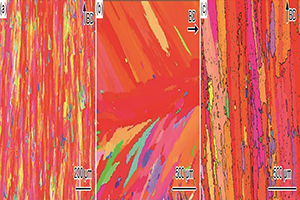
1 增材制造方法
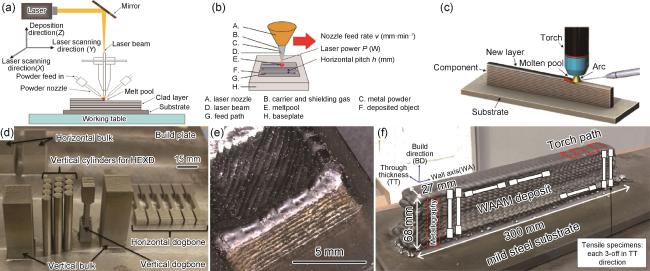
| Additive manufacturing method | PBF | DED | WAAM | |
| Preparation process | Raw material form | Metal powder | Metal powder | Metal wire |
| Work environment | Inert gas, vacuum | Inert gas, vacuum | Atmospheric environment | |
| Heat source | Laser or electron beam | Laser or electron beam | Electric arc | |
| Construction space | Limited | Large, flexible | Unlimited | |
| Layer thickness | Thin | Moderate | Thick | |
| Construction speed | Low | Moderate | High | |
| Surface roughness | Good | Normal | Bad | |
| Product | Component dimensions | Small | Medium | Large |
| Complexity level | Very complicated | Complicated | Complicated | |
| Molding precision | High | Moderate | Low | |
| Postprocessing | No need | Simple | Complex | |
| Advantage | High precision, suitable for multiple materials | Versatile application for multiple materials, manufacturing large components with high raw material | Low cost, fast preparation speed, manufacturing of very large components, applicable in repair processes | |
| Limitation | Limited construction volume, requires a supply of inert gas | The surface quality and manufacturing precision are relatively low | The surface quality and manufacturing precision are low | |
1.1 粉末床熔化
1.2 定向能量沉积
1.3 电弧增材制造
2 增材制造镍基合金
2.1 常用增材制造镍基高温合金
表 2 常见增材制造用镍基高温合金的成分(质量分数/%)Table 2 Composition of common nickel-based high-temperature alloys for additive manufacturing(mass fraction/%) |
| Composition | IN718[30] | IN625[31] | Hastelloy X[32] | CM247LC[33] | IN738LC[34] |
| Co | < 1.0 | 1.72 | 9.2 | 8.3 | |
| Cr | 18.35 | 20.0-23.0 | 21.11 | 8.3 | 15.88 |
| Fe | 18.59 | < 5.0 | 18.88 | ||
| Nb | 5.13 | 3.15-4.15 | 0.9 | ||
| W | 0.4 | 9.4 | 2.6 | ||
| Mo | 3.08 | 8.0-10.0 | 8.46 | 0.58 | 1.8 |
| Ta | 3.2 | 1.9 | |||
| Al | 0.51 | < 0.4 | 0.06 | 5.5 | 3.51 |
| Ti | 1.09 | < 0.4 | ≤0.05 | 0.8 | 3.31 |
| Hf | 1.5 | ||||
| C | 0.08 | < 0.1 | 0.069 | 0.08 | 0.1 |
| B | 0.004 | 0.01 | |||
| Zr | 0.03 | ||||
| Si | 0.22 | < 0.5 | 0.48 | ||
| Mn | < 0.5 | 0.58 | |||
| Ni | Bal | Bal | Bal | Bal | Bal |
2.2 增材制造镍基高温合金的微观组织
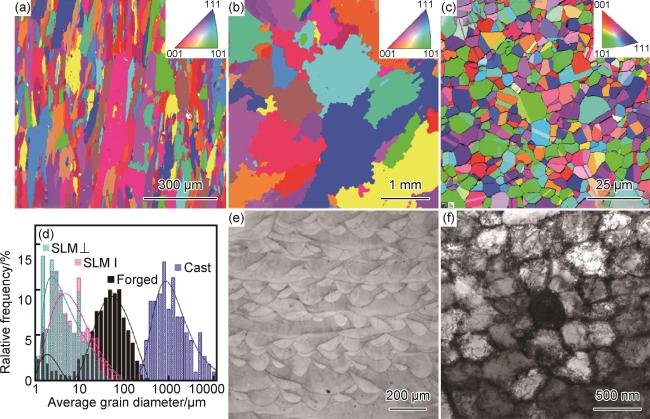
图 2 通过不同的方法制备的镍基高温合金显微组织形貌[42-46](a)与构建方向平行的SLMed IN718样品;IN718铸件样品(b)和未经热处理的轧制IN718合金(c)的EBSD图;(d)SLM、铸造、锻造IN718的晶粒尺寸分布;(e)SLMed IN718合金显微组织特征的OM图像;(f)SLMed IN718的传统BF显微照片显示柱状位错单元的形成 Fig.2 Microstructure morphology of nickel-based superalloys prepared by different methods[42-46] (a)SLMed IN718 samples parallel to the building direction; EBSD diagrams of IN718 casting sample(b) and rolled IN718 alloy without heat treatment; (d)grain size distributions of SLM, cast and forged IN718;(e)OM image of microstructure characteristics of SLMed IN718 alloy; (f)traditional BF micrograph of SLMed IN718 shows the formation of columnar dislocation cells |
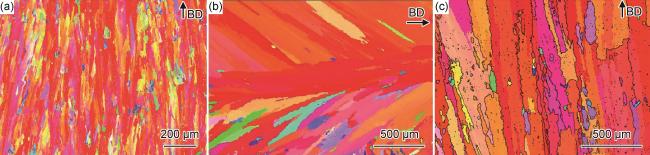
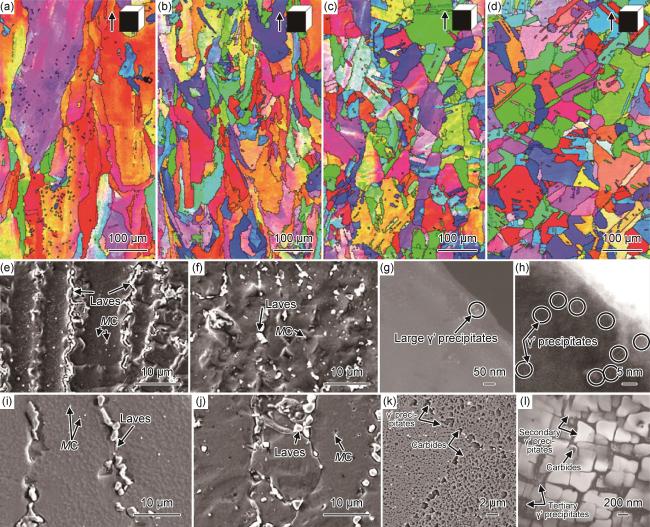


图 4 通过热处理调整后增材制造镍基高温合金显微组织的变化[67-69]合金状态(a)、应力释放后(b)、固溶热处理(c)和热等静压后(d)的EBSD图像;未经热处理(e)、1000 ℃(f)、1100 ℃(g)、1200 ℃(h)的有害相和碳化物相析出情况;(i),(j)打印态下被抑制的析出相;(k),(l)SLM+HT样品的BSE SEM图显示γ′的双峰分布 Fig.4 Changes of microstructure of additive nickel-based superalloy adjusted by heat treatment Image of EBSD grain structure after alloy state (a), stress release(b), solution treatment(c) and hot isostatic pressing(d); harmful phase and carbide phase precipitation without heat treatment(e) at 1000 ℃(f), 1100 ℃(g) and 1200 ℃(h); BSE SEM images of γ′ precipitates in printed inhibited precipitates(i), (j); (k), (l)SLM + HT sample shows bipeak distribution of γ′ |
2.3 增材制造镍基高温合金的力学性能
表 3 不同制备方式下IN625合金的室温拉伸性能Table 3 Room temperature tensile properties of IN625 alloy under different preparation methods |
| State | Yield strength/MPa | Tensile strength/MPa | Elongation/% | Reference |
| LPBF | 743 | 1043 | 31.4 | [87] |
| LPBF+annealing | 386 | 910 | 54.4 | |
| LPBF | 585 | 864 | 58.6 | [88] |
| LPBF+HT | 507 | 827 | 69.3 | |
| LPBF | 641.5 | 878.5 | 30 | [89] |
| LPBF | 788 | 998 | 19.1 | |
| LPBF+HT | 585 | 1000 | 31.5 | |
| LPBF | 652±10 | 925±13 | 32±3 | [90] |
| LPBF+HT1 | 567±15 | 869±7 | 38±1 | |
| LPBF+HT2 | 409±14 | 886±11 | 56±5 | |
| LMD | 723±23 | 1073±5 | 26±2 | |
| LMD+HT1 | 654±15 | 1084±2 | 27±2 | |
| LMD+HT2 | 532±22 | 991±13 | 43±1 | |
| WAAM | 376.9 | 647.9 | 46.5 | [91] |
| WAAM | 391.4 | 675.6 | 44.45 | |
| WAAM | 400.8 | 687.7 | 43 | |
| Cast | 350 | 710 | 40 | |
| Wrought | 517 | 930 | 40 | [92] |
Note:HT-heat treatment; LMD-laser melting deposition |
表 4 不同制备方式下IN718合金的室温拉伸性能Table 4 Room temperature tensile properties of IN718 alloy under different preparation methods |
| State | Yield strength/MPa | Tensile strength/MPa | Elongation/% | Reference |
| LNSM | 552 | 904 | 16.2 | [93] |
| LNSM+HT | 949 | 1194 | 19.9 | |
| Cast | 758 | 862 | 5 | |
| Wrought | 1034 | 1276 | 12 | |
| LPBF | 668±16 | 1011±27 | 22±2 | [94] |
| LPBF+HT | 875±11 | 1153±4 | 17±2 | |
| LPBF+HIP | 645±6 | 1025±14 | 38±1 | |
| LPBF+HIP+HT | 1145±16 | 1376±14 | 19±1 | |
| LRF+HT | 590 | 845 | 11 | [95] |
| LRF+HT | 1133 | 1240 | 9 | |
| LPBF | 1185 | 1430 | 18.6 | [40] |
| LDED | 650 | 1000 | 38 | [96] |
| LDED+HT | 1204 | 1393 | 13 | |
| LDED+HT | 1257 | 1436 | 13 | |
| LPBF | 711±14 | 1110±11 | 24.5±1.1 | [97] |
| LPBF | 858±12 | 1167±10 | 21.5±1.3 | |
| LPBF | 580 | 845 | 20 | |
| LPBF | 737±4 | 1010±10 | 20.6±2.1 | |
| LPBF | 800 | 997.8 | 28 |
Note:LNSM-laser net shape manufactured; LRF-laser rapid forming; HIP-hot isostatic pressing |
表 5 不同制备方式下Hastelloy X合金的室温拉伸性能Table 5 Room temperature tensile properties of Hastelloy X alloys under different preparation methods |
表 6 不同制备方式下CM247LC和IN738LC合金的室温拉伸性能Table 6 Room temperature tensile properties of CM247LC and IN738LC alloys under different preparation methods |
| Material | State | Yield strength/MPa | Tensile strength/MPa | Elongation/% | Reference |
| CM247LC | HIP | 815 | 1350 | 12.7 | [101] |
| M-M247 | BJ+HT | ≈900 | ≈1000 | ≈2 | [102] |
| BJ+HIP+HT | ≈1000 | ≈1100 | ≈3 | ||
| MIM+HIP+HT | ≈800 | ≈1300 | ≈11 | ||
| VIC+HIP+HT | ≈1000 | ≈1100 | ≈5 | ||
| CM 247LC | LPBF+HIP | ≈800 | ≈1250 | ≈10 | [103] |
| LPBF | ≈800 | ≈1000 | ≈5 | ||
| CM247LC | Cast | 799.79 | 920.3 | 10.39 | [104] |
| HIP1 | 738.95 | 771.93 | 1.28 | ||
| HIP2 | 738.55 | 973.87 | 15.98 | ||
| IN738LC | Cast | 896 | 1034 | 7 | [105] |
| LPBF+HT | 981 | 1450 | 14 | ||
| LPBF+HIP+HT | 932 | 1350 | 14 | ||
| IN738LC | Cast | 765 | 945 | 7.5 | [106] |
| LPBF-XY | 933 | 1184 | 8.4 | ||
| LPBF-Z | 786 | 1162 | 11.2 | ||
| IN738LC | PPAAM | 902 | 1084 | 6 | [107] |
| PPAAM+HT | 1081 | 1272 | 3.5 | ||
| LMD | 1350 | 1392 | 1.13 | ||
| LMD+HT | 1038 | 1117 | 2.76 | ||
| LPBF | 786-933 | 1162-1184 | 8.4-11.2 | ||
| LMD | 1058-1073 | 1093-1116 | 1.2-1.4 | ||
| LSF | 871 | 1074 | 10.8 | ||
| Cast | 765 | 945 | 7.5 | ||
| IN738LC | CAST | 765 | 945 | 7.5 | [108] |
| LPBF | 895 | 1010 | 1.6 | ||
| IN738LC-0.024%Zr | LPBF-XY | 930 | 1113 | [109] | |
| IN738LC-0.12%Zr | LPBF-XY | 764 | 947 |
Note:BJ-binder jetting; MIM-metal injection molding; VIC-vacuum investment casting; PPAAM-pulsed plasma arc additive manufacturing; SLF-laser solid forming |