
- Ei,ESCI收录期刊
- 中国科学引文数据库(CSCD)核心期刊
- 中文核心期刊
- 文摘与引文数据库(Scopus)
- 剑桥科学文摘(CSA)




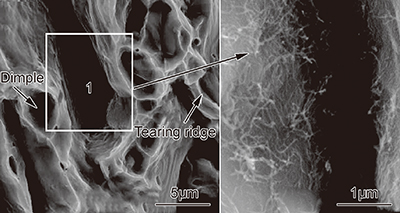
The composite powders of 2%-CNTs were prepared by wet ball milling and hydrogen annealing treatment-cold pressing sintering was used to consolidate the ball milled composite powders with different modifications of the CNTs. The results show that the length of the CNTs is shortened, ports are open, and amorphous carbon content is increased by ball milling. And after a mixed acid purification, the impurity on the surface of the CNTs is completely removed,and a large number of oxygen-containing reactive groups are introduced; the most of CNTs can be embedded in the Cu matrix and the CNTs have a close bonding with the Cu matrix, forming the lamellar composite structure, then, ultrafine-grained composite powders can be obtained by hydrogen annealing treatment. Shortening and purification of the CNTs are both good for dispersion and bonding of CNTs in the Cu matrix, and the tensile strength and hardness of the composites after shortening and purification reaches the highest, and is 296MPa and 139.8HV respectively, compared to the matrix, up to 123.6% in tensile strength and 42.9% in hardness, attributed to the fine grain strengthening and load transferring.
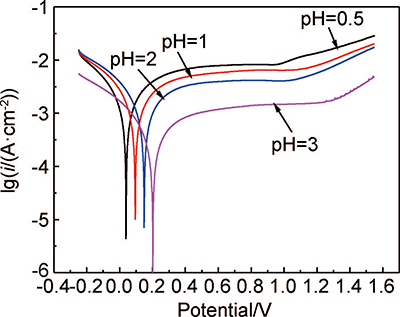
By correction to the thermodynamic calculation based on E0-pH diagram of MnSO4-SO42--H2O plating system, effective pH value range for anodic electrodeposition of MnO2 phase structure materials got clear, at 363K, with Mn2+ concentration 0.2mol·dm-3. The influence law of the pH values was also obtained based on the characterization of the oxide structure and test of its electrochemical performance. The results show that pH value in the 0.33-3.4 range, with its increase and accordingly the conducive to the effective deposition of MnO2 type Mn-Mo oxide. However, although with pH value increasing, deposition efficiency improves, the coating quality gets degraded, especially making the electrocatalytic performance of the oxide obviously deteriorated. It also shows that with pH value of plating solution 0.5, obtained Mn-Mo oxide has excellent coating quality and high electrocatalytic activity. The reason is closely related to competition in oxygen evolution reaction during the preparation of the oxide. When pH value is small, oxygen evolution reaction competition causes the solid-liquid interface stirring, the dendritic growth of oxide gets inhabited and the diffusion layer gets thinning, which promotes the nucleation of oxide on the electrode micro-surface and makes grain refined, so as to improves the electrocatalytic performance of oxide.
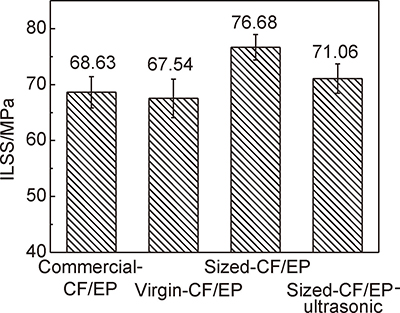
The sizing treatments were used to introduce carbon nanotubes (CNTs) to carbon fiber (CF) surfaces for fabrication of CF/CNTs/epoxy multi-scale composites. Comparing with the base composites without CNTs, interlaminar shear strength (ILSS) and flexural strength of the modified composites were increased by 13.54% and 12.88%, respectively. Force modulation atomic force microscope and linear scanning system of scanning electron microscope were carried out to analyze the microstructure of composite interface. The results indicate that a transition layer reinforced by CNTs is constructed between fiber and epoxy (EP) matrix, which has certain thickness and exhibits gradient distribution of modulus and carbon element content. The composites containing CNTs are sonicated before curing to disperse CNTs in the surrounding resin. As a result, the interface transition layer is weakened and the ILSS and flexural strength of prepared composites decrease by 7.33% and 5.34%, respectively. Therefore, the significant role of the interface transition layer in improving the interfacial performance of composites is evidenced again at another perspective.
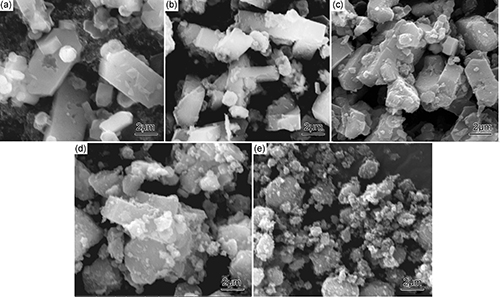
HZSM-5 supported SrTiO3 was prepared using sol-gel method. The materials were characterized by XRD, SEM, BET, BJH and FT-IR measurements. The activity of photocatalytic degradation of reactive brilliant red X-3B was studied on SrTiO3/HZSM-5. The results show that SrTiO3 material is mainly composed of perovskite SrTiO3, as well as a small amount of SrCO3 phase. SrTiO3 is coated on the external surface of HZSM-5 in the χSrTiO3/HZSM-5. The specific surface area of the supported materials is mainly provided by the zeolite, while pore size in the materials is mainly in the range between 2-20nm. Photocatalytic activity of SrTiO3 is obviously enhanced after being supported, and the 30%SrTiO3/HZSM-5 has the maximum activity. 93.8% of reactive brilliant red X-3B can be degraded on 30%SrTiO3/HZSM-5 after 90 minites irradiation, while only 23.9% of the dye can be degraded on pure SrTiO3.
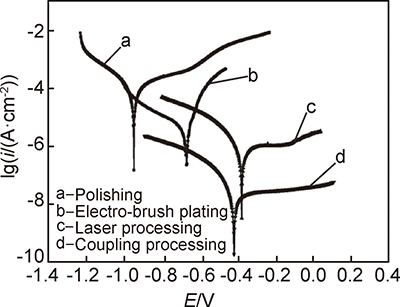
To obtain a superhydrophobic aluminum alloy surface, a kind of special coupling structure was fabricated on the aluminum alloy surface by a couple ways which was electro-brush plating combined with laser processing. The surface has excellent anti-adhesion and corrosion resistance property. The contact angle can reach as high as 155.1°, while the sliding angle less than 5.6°. The morphological feature, chemical structures, and wettability of resultant surfaces were characterized by scanning electronic microscope (SEM), X-ray diffraction (XRD) and water contact angle measurements. The surface corrosion resistance was researched by a corrosion resistance experiment. The results show that surface consists of micro-scale grooves and like-cauliflower mastoids, the grooves in a regular arrangement with mastoid structures for a coupling structure on the surface. The special coupling structure makes the surface already have superhydrophobicity. The wettability of the surface changes from hydrophilicity to superhydrophobicity. There have no peaks from other phases can be detected between electro-brush plating surface and aluminum alloy substrates. The peak intensity is changed by laser processing, and the organization structure of the material is further refined. The corrosion resistance of the surface that is fabricated by couple ways improves.
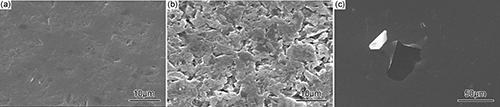
To improve the interfacial bonding properties of SiC-aramid fiber reinforced polymer matrix composites (SiC-AFRP), the influences of etching process of SiC ceramic, coupling treatment process, and the adhesives types on the interfacial peel strength of SiC-AFRP were studied. The results show that the surface etching process and coupling treatment process of silicon carbide ceramic can effectively enhance interfacial bonding property of the SiC-AFRP. After soaked the ceramic in K3Fe(CN)6 and KOH mixed etching solution for 2 hours, and coupled with vinyl triethoxy silane coupling agent, the interfacial peel strength of the SiC-AFRP significantly increases from 0.45kN/m to 2.20kN/m. EVA hot melt film with mass fraction of 15%VA is ideal for interface adhesive.
A kind of Al-Zn-Mg-Cu alloy containing 9.6%(mass fraction) Zn element was produced by the Hot-top semi-continuous DC casting technology. The microstructure of the alloy and the temperature of phases transformation were investigated by optical microscopy(OM),transmission electron microscopy(TEM) and differential scanning calorimetry(DSC) respectively.The hardness and tensile properties of the alloy were tested,and the fracture was studied by scanning electron microscopy(SEM).Results show that the as-cast microstructure of this alloy is fine and has less intergranular eutectic phases, with the melting temperature of 473.4℃. Therefore, the homogenization heat-treatment is 465℃/24h. After the homogenization heat-treatment, the grain boundary of the ingot has turned to be intermittent and the phases have dissolved significantly. Besides, the systematic experiments were conducted on the T6 and RRA of this alloy after extrusion. The results show that on the condition of 135℃/12h treatment, the highest hardness is 197.7HBS, and the tensile strength, yield strength, elongation are 727.5, 718.0MPa and 9.3% respectively. On the condition of 120℃/24h+190℃/5min+135℃/3h treatment, the highest hardness is 204.7HBS, and the tensile strength, yield strength, elongation can reach 764.0, 749.0MPa and 7.2% respectively.

ZnO nanorods and RGO/ZnO nanorods composites were prepared by hydrothermal method. The influence of RGO content on the photocatalytic activity of RGO/ZnO nanorods composites was studied. ZnO nanorods and RGO/ZnO nanocomposites were characterized by X-ray diffraction (XRD), field emission electron microscopy (FESEM), X-ray photoelectron spectroscopy (XPS) and diffuse reflectance UV-visible absorption spectroscopy techniques. The results show that RGO/ZnO samples are synthesized successfully. With different additions of GO, the RGO/ZnO samples obtained exhibit different absorption characteristics in visible light region. The photocatalytic results of using methyl orange (MO) as the simulated pollutant show that RGO/ZnO nanorods composites exhibit high degradation efficiency under UV-Vis light illumination. The highest photocatalytic performance is obtained for RGO/ZnO composites when the mass ratio of RGO to ZnO is 3%. MO is almost completely degraded in 120min. RGO/ZnO also shows the visible-light-driven photocatalytic activity under visible light illumination (λ>400nm), and the maximum MO degradation efficiency in 180min can reach 26.2%, meanwhile, RGO/ZnO samples exhibit good photostability.
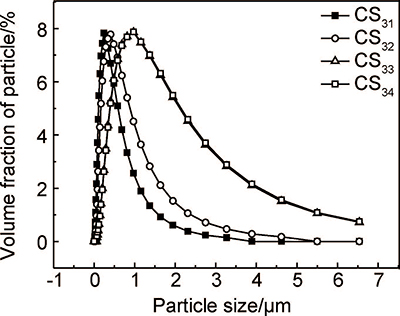
With ethyl alcohol or distilled water as process control agent (PCA), micron chitosan powder was prepared by ball milling method. The yield rate, particle size distribution, micro morphology, viscosity average molecular mass, chemical and crystal structures, and thermal properties of these different micron chitosan powders were measured. The results indicate that the yield rate of micron chitosan powders prepared with ethyl alcohol as PCA increases significantly, and improves to 94.7% from 25% while the amount of ethyl alcohol is 0.75mL/g. The particle size distribution of micron chitosan powder prepared with ethyl alcohol as PCA is concentrated, while the D50 and D90 in size are 824nm and 1629nm respectively. Chitosan do not react with ethyl alcohol used as PCA, but the viscosity average molecular mass of prepared micron chitosan powder decreases by 23%, the crystal structures are destroyed slightly, and its thermal stability is slightly weakened.
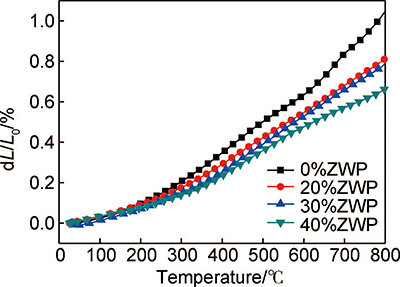
Zr2P2WO12 powder was successfully prepared by using hydrothermal method, followed by preparation of Zr2P2WO12/Fe-Ni composites close to the density by using vacuum hot pressing sintering method. The performance and characterization of Zr2P2WO12 and Zr2P2WO12/Fe-Ni composites materials were carried out by X-ray diffraction (XRD), scanning electron microscopy (SEM) and thermal expansion analyzer. In addition, the hardness of the composites was tested using Vickers hardness instrument and the density of the as-prepared composites was characterized by using drainage method. The results show that the Zr2P2WO12 powder prepared by hydrothermal method is single-phase of high purity. The grain of Zr2P2WO12 powder is regular and the grain size is about 50nm. With the increase of Zr2P2WO12 percentage, the hardness of Zr2P2WO12/Fe-Ni composites increases, while the density and the relative density decrease. The average thermal expansion coefficient of the as-prepared composites decreases from 13.5×10⁻⁶/℃ to 8.6×10⁻⁶/℃ with the temperature changing between 25℃ and 800℃.

Cellulose/TiO2 composite was prepared by sol-gel method using the ionic liquid BMIMCl as reactive medium and Ti(OBu)4 as a precursor. The synthesis conditions were optimized by single-factor experiment. The structure and properties of the composite were characterized by scanning electron microscope (SEM),X-ray diffraction(XRD),Fourier transform infrared spectoscopy(FT-IR),UV-vis-diffuse reflectance spectroscope(DRS) and thermogravimetric (TG) analysis. The photocatalytic activity of the composite was investigated via testing the photodegradation of methyl orange in aqueous suspension under UV-light. The results show that the high active photocatalytic composite is prepared by using ionic liquid BMIMCl as medium at room temperature and atmospheric pressure. The photo catalytic degradation rate of composite on methyl orange(MO) reaches 97.09% in 80min. Comparing with bare TiO2, the degradation rate of MO increases by 37%. Moreover, the composite still shows 62.66% degradation rate towards MO after recycling 4 times.
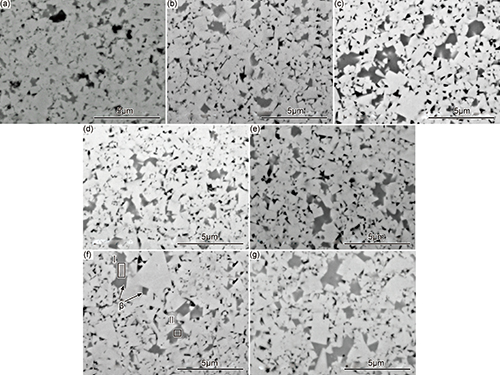
A series of WC-1.0TiC-3.1TaC-4.5Co cemented carbides were prepared by vacuum sintering and Sintering-HIP through traditional powder metallurgy method. Optical microscopy(OM),scanning electron microscopy (SEM) and energy dispersive X-ray spectroscopy (EDS) were used to characterize the microstructures. The results show that pores and cobalt-lake can be reduced in cemented carbides by increasing sintering temperature or using Sintering-HIP. The mean size of WC cemented carbide prepared by vacuum sintering process is larger than that prepared by Sintering-HIP. Furthermore, the phenomenon of WC abnormal growth was found in the cemented carbides prepared by Sintering-HIP.
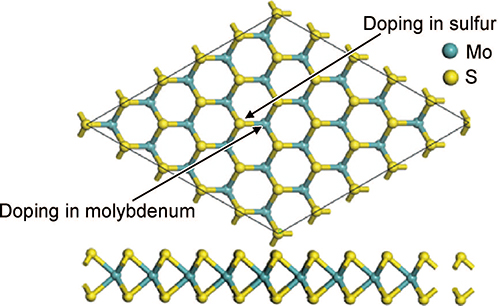
Based on the first principle, the bond length, band structures and density of states of Cu, Ag and Au doped monolayer MoS2 were studied. The effects of Cu, Ag and Au doped on the monolayer MoS2 electronic structure were discussed. The results show that the impurity energy of Cu, Ag, Au doping at the S position always lower than that doping at the Mo position, so that there is the more stably of Cu, Ag, Au doping at the S position. When the Cu, Ag, Au dope at the S position, the bond length of impurity atom and nearest neighbor S, Mo atom are distorted, the maximum of aberration rate dAu-Mo is up to 23.8%.Comparing with the monolayer MoS2,the doped system appears four new energy levels in forbidden band. The energy of the conduction band and valence band turns to the low energy region.Charge gathers around impurity atoms,at the same time,a charge loss exits.
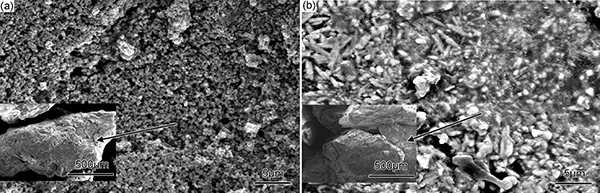
By adding TiO2 powder into the preform, Al2O3 particles reinforced 1065 steel matrix composites were prepared by squeeze casting. The influence of TiO2 on the microstructure and mechanical properties of the composites was investigated. The results indicate that TiO2 and Al2TiO5 were produced at the interface between matrix and Al2O3 particles. Hardness and three point bending strength reach 39.0HRC and 743.94MPa respectively, which was 10.0% and 26.4% higher than those of the composites without TiO2 powder. Fracture morphologies show that there is no crack at the interface and Al2O3 particles are transcrystalline rupture. The interface bonding is improved by TiO2 powder for the Al2O3 particles reinforced composites, and the mechanical properties of the composites increase.
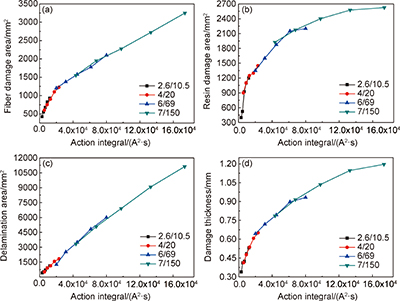
The thermal-electric finite element simulation model of carbon fiber reinforced plastic(CFRP) damage caused by lightning strike was established. The superimposed temperature was treated as the internal injury. The accuracy and effectiveness of coupled thermal-electric simulation method were verified by comparing with the experimental results. The regression analysis was taken into consideration to give a quantitative analysis of lightning parameters and CFRP lightning damage, and the relevant curves were drawn. The results show that action integral is a key factor in determining the injury status of CFRP laminates. Fiber damage area and delamination area have a linear relationship with the action integral. And resin damage area and damage thickness have a logarithmic relation with the action integral.
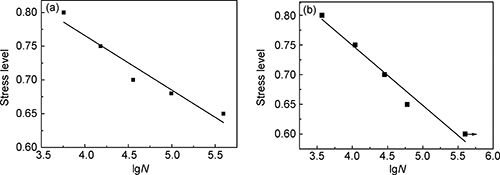
Compression-compression fatigue tests were carried out on T300/5405 composite laminates after low-velocity impact, compression performance of the laminates with different impact damages was studied together with its fatigue life and damage propagation under different stress levels, then the effects of impact energy, stress level and damage propagation on fatigue life of laminates were discussed. The results indicate that impact damage can greatly reduce the residual strength of laminates; under low fatigue load levels, the higher impact energy is, the shorter the fatigue life of laminates with impact damage will be; damage propagation undergoes two stages during the fatigue test, namely the steady propagation and the rapid propagation, accounting for 80% and 20% of the overall fatigue life, respectively; damage propagation rate decreases with the reduction of stress level.
Graphene oxide (GO) has wide applications and development prospects in the functional composites owing to its many unique properties, such as two-dimensional structure and large theoretical specific surface areas as well as hydrophilic and polarized interface. The present situation and progress of the graphene oxide composites used in reinforcing and toughening, adsorption separation, photocatalysis and biological medicine were introduced in this paper. The mechanism of producing reinforcing and toughening of polymer and cement based composites caused by forming regular and ordered microstructure regulated with GO nanosheets was mainly summerized. Meanwhile, application principle of the GO composites in the field of adsorption, photocatalysis and biological medicine were analyzed. Finally, the application and development trend of GO composites in reinforcing and toughness as well as adsorption and photocatalysis were pointed out.
Superhydrophobicity and superhydrophilicity are extreme properties of solid surface governed by surface morphology and surface chemistry. Switching between superhydrophobicity and superhydrophilicity can be achieved by applying external stimuli and exchanging counterions due to the change in surface morphology and/or surface chemistry. This review mainly gives a concise overview of switchable wettability of surface. Through applying external stimuli such as light, temperature, pH value, solvent, electric potential and exchanging of counterions, the wettability of surface can switch between superhydrophobicity and superhydrophilicity. The material with asymmetric wettability exhibits some novel abilities such as directional liquid transport. Finally, the advances of surface with switchable wettability are prospected. By controlling the micro-nano structure and chemical composition, the switch between superhydrophobicity and superhydrophilicity can be realized on various surfaces.
|
Founded in 1956 (monthly) ISSN 1001-4381 CN 11-1800/TB Sponsored by AECC Beijing Institute of Aeronautical Materials |

